History of the BMW Logo

The history of the BMW logo is as controversial and enigmatic as the history of the company itself, and it begins in the dying months of World War One…

The BMW Logo - Bavarian colours of blue and white
Photo by Luis Quintero

BMW can trace its roots to the Rapp Motorenwerke, created in 1913 by Karl Rapp. Developing and building aircraft engines on the outset of WW1, the business saw moderate success until Rapp’s departure in 1917. It was then renamed the Bayerische Motoren Werke (Bavarian Motor Works), yet this new firm had no logo for months, only its registered name. The reason is simple – it didn’t need one; its sole customer was the German Air Force.

It was on 5th October 1917 that the famous blue and white badge was trademarked. The colours are those of the Bavarian national flag, and it carries the tradition of a black border from Rapp’s own logo bearing the company name. By then, BMW was already deep into development of an aircraft engine the likes of which hadn’t been seen before. Named the BMW IIIa, it was an inline six-cylinder capable of 200hp at a height of over 6000ft. When bolted onto the Fokker D VII, the German Air Force had an aircraft that could out-climb and out-maneuver anything the allied nations could send against it.
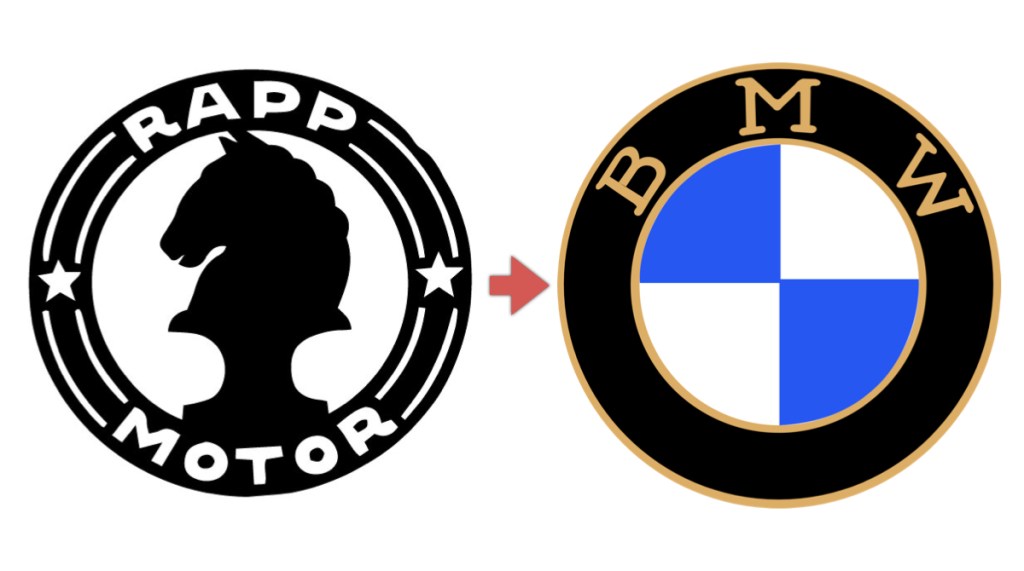
The logo’s origin
WW1 photograph of a Fokker D VII aircraft outside a hangar
A Fokker D VII

The small company faced unprecedented demand for ever more IIIa engines, and over 700 were eventually built. But this success came too late to change the outcome of the war, and Germany finally accepted defeat on 11th November 1918.

When the victorious allies placed the BMW IIIa on a test rig, the results astounded them. Clocking 230hp, it represented a leap in technology far greater than anything they had come up with. In fact, so scared, so terrified were they, that the Treaty of Versailles was given an extra clause – BMW were no longer allowed to design or build aircraft engines.

Facing imminent collapse, the company shifted to the manufacture of farm equipment and industrial engines. This interwar period was a difficult time for BMW, and there came a flurry of take-overs, acquisitions and mergers in the German market that it somehow managed to survive. Coming out the other side producing automobiles with a new confidence, the firm made a nod to its aircraft origins (and a ‘screw you’ to the Versailles Treaty) with an advertising campaign portraying its badge as a stylised whirring propeller.

1929 advertisement for BMW, showing its link to aviation

And so the legend of the BMW logo being a stylised white propeller against a blue sky was born. In the decades since, it has become an urban myth, and one that BMW itself has not distanced itself from, stating, “it is not strictly true there is a propeller in BMW’s logo.”

Instead, it seems BMW’s marketing team views it more as a happy coincidence they are content to allow to endure through the years. And it makes a great story, one that its millions of loyal customers can tell at dinner parties whilst admiring their BMW key fobs.

Certainly it is a far more palatable story than the one that comes from the ashes of World War Two. If you were to have shown the BMW logo to any one of the survivors from German concentration camps such as Dachau and Auschwitz, their reaction would surely have been one of horror and revulsion. Towards the end of WW2 in 1945, more than half the 56,000 workforce at BMW were used as forced labour from concentration camps. These people were made to work more than 12 hours a day, were whipped, beaten and even killed for the most trivial of mistakes. Reduced to drinking toilet water to survive, BMW’s mass production for the German war effort could not have succeeded without them.

Concentration camp victims forced to work at a BMW plant in Allach
An image taken at a BMW production camp that should bury the company. Instead, its net worth today is more than £45,000,000,000

For the longest time, BMW made every attempt to conceal its participation in the atrocities, and only began accepting their responsibility in 1999 once the vast majority of direct victims had passed away and were therefore unable to claim any kind of compensation.

Against this backdrop, BMW made the latest iteration of their logo in 2020. On its unveiling, the words of its Senior Vice President Customer & Brand Department, Jens Thiemer, must surely leave him a sour taste in the mouth:

“BMW becomes a relationship brand. The new communication logo radiates openness and clarity,” 

Jens Thiemer
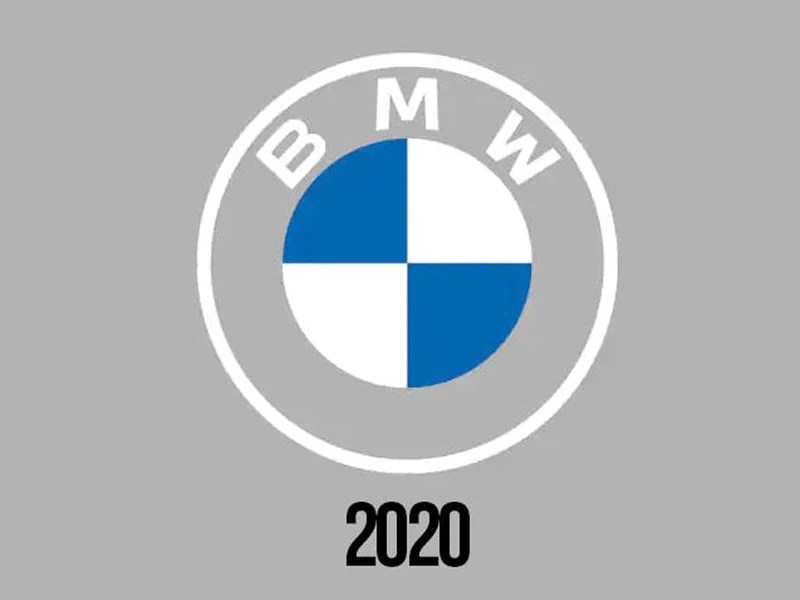
Latest BMW logo unveilied in 2020

Or perhaps the change is rather fitting. By uglifying the brand, perhaps BMW is sending a message – that the openness and clarity they claim to hold themselves to is revealing a dark, murky past still coming to the light.

It also fits well with my own assertion in a previous post – we can’t make beautiful things anymore.

Why Can’t We Make Beautiful Things Anymore?

For the first time in a long time, I returned to my old family home for a fleeting visit last week, and I was reminded just how much time, effort and craftsmanship had been put into all its fixtures and fittings. Everything down to its old brass bathroom taps have an ornate design that the chrome-effect ones at my own home just can’t compete with.

The door frames have hand-carved motifs in the top corners, and the original doors themselves are solid, unlike my own new-build plywood-esque ones. Returning to my own home nestled amongst a warren of identical brick boxes, I realised just how soulless our modern environment is.

Just a few days ago, I attended a friend’s wedding and was struck (not literally) by the car whisking the bride and groom away to their new life together (or at least as far as the reception venue). It was a 1950’s Cadillac, and it was absolutely beautiful. For my own wedding, my wife chose us a 1960’s Rolls Royce Silver Shadow in all its impeccable glory. She could have chosen any one of a plethora of shiny modern cars-to-hire like a Mercedes SLK or a brand-spanking new Bentley. But like most brides, she went for something old. What makes us harken to the past at the most important events of our life? Could it be that its relics we’re left with were built with a passion and a heart we no longer have?

The more I look around at our modern world, I can’t help but notice how wrong things are. Our streets are dirty and choked with litter. The people are walking around in jogging bottoms and pyjamas. Watching vintage footage of London, it’s almost painful to see how clean it all looks, how well-dressed the people are, even those we would consider poor today. Where and why did it come crashing down?

Tesla car, the design of which has been widely described as ugly
Say what you like about the technology – this has no character at all…
A quintessential red Chevrolet. Guaranteed to bring a smile
…Whereas this has bags of it without even trying

I think the answer is simple; it’s down to two things – pride and purpose. Case in point – Crossness Pumping Station in London. Designed by James Watt & Co in the 19th Century, it has a simple purpose – to pump raw human sewage up 12 metres from the south of the River Thames to a reservoir. Below is an image showing what it looks like.

This was made for the sole purpose of pumping human faeces from one place to another

Incredibly, it has the Monarch’s initials cast into its metalwork – VR, Victoria Regina, and its opening was attended by the Archbishop of Canterbury. People had so much pride in their work back then, it seems completely alien to us now. When was the last time our current Archbishop attended the opening of a shit-pumping station?

Big Ben London. Recently restored
We would never dream of building this today

It’s bewildering to the point of depression having to live in the shadow of previous generations’ efforts that we struggle simply to maintain today. I’m starting to hate how ugly our current creations are, how little creativity there is, and this laziness is poisoning our culture. Look at the movies we flock to see – how many of them are remakes of old classics? How many are retellings of old stories? Whether it’s superhero blockbusters or period dramas, we seem to have forgotten how to tell new tales, how to create something truly unique, something with a soul.

old photograph of a well-dressed child playing with his pet dog

Is it any wonder we’re living through an epidemic of mental illness here in the West? We wake up on polyester bedsheets only to get dressed in polyester clothes before making a morning coffee in a plastic machine. Going to work on the public transit system is about as inspiring as getting root canal treatment at the dentist, and when we do finally get to work, our environment is drab and utilitarian.

Public transport system. Cramped, dirty, soulless
There is nothing healthy about this
A sterile office space without decoration
…Or this

I’ve pinpointed this decline to somewhere at the end of the 1970s. Around this time, we decided to churn out mass-produced rubbish to the point where our devices are designed to fail after a period of 5 years. Things have gotten so bad, the UK Government has had to introduce a law that prevents designed obsolescence in white goods. Craftsmanship has been replaced by profit, and pride replaced by convenience. And all of us are suffering for it.

Sony Walkman, now in museums
This plastic box is in museums now...
A vintage gramophone
…While craftsmanship like this is gathering dust in a knock-down antique shop

Bit by bit, I’m pushing back on the encroachment of this uglification by surrounding myself with beautiful things from the past. Whether it’s something as simple as an old writing desk or an antique cabinet repurposed as a TV stand, I’m finding solace in the idea that if our ancestors understood the importance of beauty in their environment, perhaps we can get it back. The problem is, I’m firmly in the minority, and while hoards of today’s youth would rather experience a music festival through the screen of a smartphone than actually live it, I fear we’re all doomed to an ugly future.

Concert-goers watching the perforamce through a smarphone
We’re all done for, I tell you