“Great story, reminds me of The Da Vinci Code,” the agent told me down the phone. I could detect her wide grin on the other end as she delivered her next remark. “But there’s no way I’m touching it. And no publishing house on earth is going to get within a hundred yards of it, either.”
“Uh huh,” I simply replied, trying to keep the disappointment out of my voice. Thanking her for her time, I ended the call and sat back to let my frustration simmer down over the next ten minutes.
I didn’t need to ask her why I’d been rejected; like every other email and phone call I’ve ever had with a publisher about my works, the response was a firm no. My other book, A Plague of Murder, was once turned away because of my stubborn refusal to allow it to be cut down from its 480,000 word count. “Would Tolstoy have butchered War and Peace to fit with a publisher’s expectations?!” I once flippantly declared.
But my latest book has an altogether different issue. It’s set almost entirely in the present day and is loaded with modern technology. It’s also a globetrotting adventure novel featuring a desperate treasure hunt, a vengeful secret society, and a strong female lead. On top of that, it’s based on years of academic research and scientific studies to keep it rooted in reality. In short, it’s a perfect holiday escape.
So why the curt rejection?
Well, the best reply I can give is the feedback I got from a friend who kindly read my first 40,000 words over the course of a rainy afternoon;
“It’s an adventure novel that explores the very origins of Islam, and if the research it’s based on is true, it reveals a secret that’s been in plain sight for almost fifteen hundred years. Forget Dan Brown; have you ever heard of Salman Rushdie, and of what happened to him?”
And therein lies the problem for any publisher gazing at such a manuscript over a strong cup of tea. Perhaps I’m being ridiculously naive with my “glad tidings, good stranger” attitude whenever it comes to discussing any form or style of literature – for me, nothing is ever off the table. Here in the West, we have thousands of fictional stories all taking inspiration from various religions. Yet so far, I haven’t read one that delves into the origins of Islam with anything like the breadth and depth of a good adventure novel (but I’m happy to be corrected in the comments below). So I’ve decided to write my own.
I have to stress, this book doesn’t pretend to be anything other than a fast-paced work of fiction, and neither does it seek to cause offence – far from it. I think it treats the whole concept of religion with great respect and doesn’t go stomping around making wild-eyed speculations. Yet it’s undeniable there is a largely untapped historical world out there – some of it is located in the Quran itself, while much is carved into monuments like the Dome of the Rock – and all of it just waiting to be explored by an author’s imagination.
Like I alluded to earlier, this part of human history is an on-off obsession I’ve had for the past three years. When I began delving into the founding of Islam, I expected to find something similar to what I was taught in school about this fascinating but well-recorded religion and its beginnings. But what I’ve found from experts in the field is endless possibilities branching out in every direction.
At the moment, I’m continuing the book’s editing, and still have its final chapters to complete. But for now, I’ll end with its introduction that I think sets the scene and gives you an idea on what to expect. I’m incredibly excited to get this project over the finish line as I believe it’s my best work yet, and I’ve got plenty more updates to come. My self-imposed deadline for publication is 1st September 2022, and there is every expectation the ebook will be absolutely free!
Until next time, stay safe!
Introduction – untitled work in progress
There exists a story, rarely ever spoken.
At the beginning of the Islamic conquest of the Middle East, just twelve years after the death of the Prophet Muhammad, there rose a great Caliph known to history as Uthman. Accused of corruption from the earliest days of his reign, his grip on power was tenuous, even as the religion ignited like wildfire throughout his lands.
By 650AD the Caliph had grown concerned at the number of variations appearing in the Quran as his domain spread beyond the Arabian Peninsula, into North Africa and Persia.
Fearing a fragmentation of his fledgling Caliphate, Uthman ordered a standard version of the holy text be prepared and distributed across the urban centres of the Islamic World. Soon, these new copies were dispatched with armed guards to the nine great cities of his growing empire, and local officials were ordered to burn their existing scriptures.
One by one, each city obeyed, and their unique Qurans were consumed by fire, never to survive the ages.
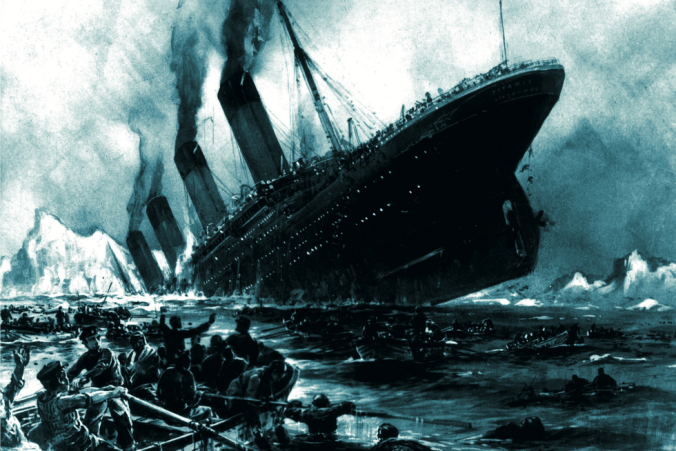
It seems everyone has heard the story of RMS Titanic. At the time of its completion, it was the largest ocean liner in history, grossing more than 46,000 tonnes and coming in at over 882 feet long. This huge ship was widely lauded as the future of transatlantic shipping only for it to sink in the early morning hours of 15 April 1912 in the North Atlantic Ocean, just four days into her voyage from Southampton, England, to New York City. The ship had more than 2,200 people on board when she struck an iceberg just before midnight on the 14th April. She sank to the bottom of the ocean two hours and forty minutes later, resulting in the deaths of more than 1,500, making it one of the deadliest maritime disasters in history outside of war.
Thanks to popular culture, we have images of those passengers in third class whose cabins were located in steerage, trapped below decks behind metal-railed gates while the ship sunk, prevented from getting up to the top decks where they could find lifeboats and salvation. All of it creates a poignant, almost melancholic defeatism about the class system at the turn of the 20th Century. But the question I’m going to ask in this post is: Were third class passengers really locked below?
Painting by Harley Crossley
Like many enquiries into the past, the answer can be found in the contemporary source documents. Following the Titanic disaster, there were two inquiries; one was set up by the British Board of Trade, and the other was conducted by the United States Senate. Their job was to question those who survived the sinking to determine what happened, why it happened, and how it could be stopped from happening again.
Both inquiries generated many hundreds of pages, and they reached many similar conclusions into what happened. I’ve trawled through their reports and witness testimony, and it is as fascinating as any court drama I have ever seen.
Focusing on the third class passengers, I was able to draw out the witness testimonies of three men, all of them survivors from third class. At some point in their interviews, each man was asked the same specific question – were you prevented from getting access to the upper decks? Using their testimonies and knowledge we now have of the event, I’m going to answer this question (hopefully) once and for all.
And I’m going to start with the testimony of a man called Berk Pickard.
Pickard has a really interesting background. He was born in Russia as Berk Trembisky before he left for France. Once in France, he took the French name of Pickard, and kept it for the rest of his life.
Stood before the United States Senate, he affirmed that he was in steerage sharing a cabin with a group of other men when the ship struck the iceberg, and he first knew of the collision at ten minutes to midnight when he was woken by a tremor running through the ship.
In his own words he states;
We had all been asleep, and all of a sudden we perceived a shock. We did not hear such a very terrible shock, but we knew something was wrong, and we jumped out of bed and we dressed ourselves and went out, and we could not get back again.
Berk Pickard
He then goes on to describe how he found some stewards already making their way down the passageway, waking up other passengers and shuttling them towards the upper levels. Pickard realised the seriousness of the situation and decided to go back to his cabin to get more belongings when he was stopped by a steward. He told the Senate how the crew would not allow the steerage passengers on this part of the ship to go back.
So far from keeping the passengers below decks, in this part of the ship at least, the crew were actively getting them out towards the top deck. Pickard continued to describe how he climbed up to another level where he found a group of passengers arguing. He stated;
One group said that it was dangerous and the other said that it was not; one said white and the other said black. Instead of arguing with those people, I instantly went to the highest spot.
Berk Pickard
He climbed his way up to an area for second class and stopped at a door. It was clearly marked for first class passengers only. Yet fortunately for Berk, it was left open, so he went on through. But then he had another problem – he had no idea where he was – he hadn’t been in this part of the ship before.
Imagine you’re suddenly in his shoes. The Titanic is sinking, and the deck you’re on is tilting ever further towards the waterline. Should you go left or right? Should you go down the first corridor you come to or do you try to seek out a set of stairs? After some time spent wandering around, Berk manages to get to the top deck where he came across a group of women and children boarding a lifeboat. Without saying a word, he climbed inside with a group of other men, and was lowered into the water where they rowed to safety. Once they were a safe distance, they all watched to the sounds of cries and screams as the ship sank, plunging to the depths far below.
Towards the end of his testimony, he was asked directly about any barriers that might have prevented him from getting to the upper decks. This is what he said;
The steerage passengers, so far as I could see, were not prevented from getting up to the upper decks by anybody, or by closed doors, or anything else. While I was on the ship no one realised the real danger, not even the stewards. If the stewards knew, they were calm. It was their duty to try to make us believe there was nothing serious. Nobody was prevented from going up.
Berk Pickard
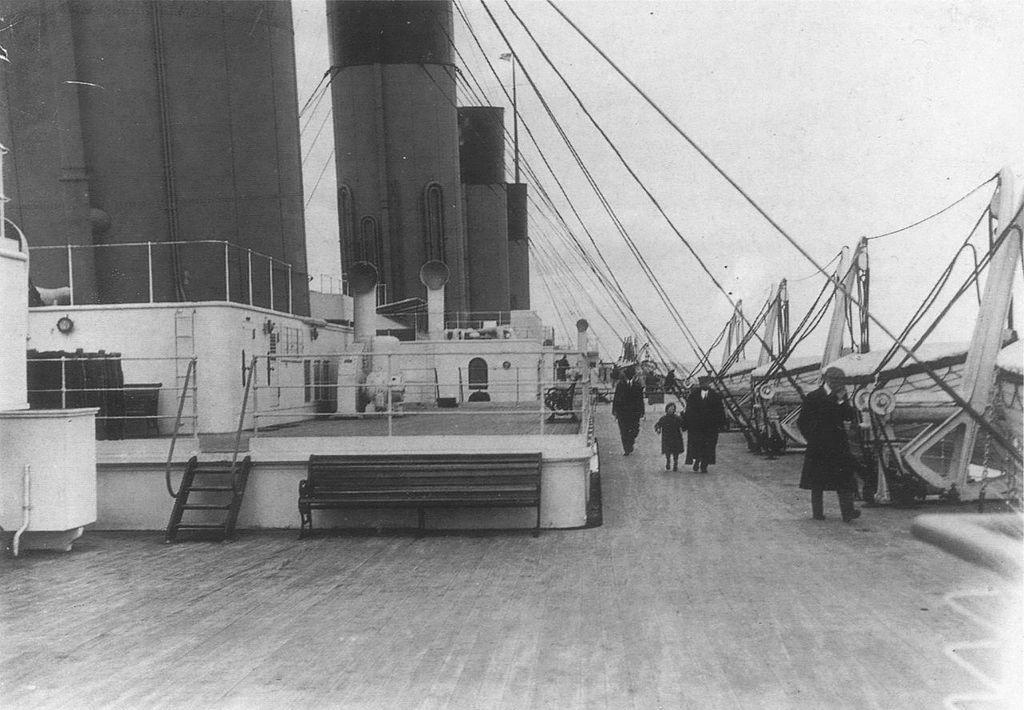
Titanic’s boat deck. Note the covered lifeboats on the right hand side
This is as clear as you can get. In Pickard’s part of the ship, there were no restrictions in getting third class passengers away to safety. And this is reflected in the second witness testimony from my research; a man called Olaus Abelseth.
Abelseth was twenty five at the time of the sinking. He was from Norway, and had gone to Southampton with his cousin and his brother-in-law to seek their fortune in the United States. He confirmed at the time of the collision how he was down in steerage after having gone to bed at 10 o’clock. He shared his third class cabin with one other man, and both of them were woken by a tremor running through the ship. Realising something was wrong, they both got dressed, and like Pickard, they left their cabin to go find out what was happening.
Abelseth told the Senate that he reached the top deck without any problems only to realise he had left his lifebelt behind. Seeing all the commotion, he realised something bad must have happened. So he went back down, grabbed his lifebelt and went to find his cousin and brother in law since they slept in a different cabin to him. After waking them up, he led the groggy pair up the ship’s decks and the trio somehow joined a group of Norwegians they had met previously during their voyage. Together as a single group, these Norwegians eventually found themselves standing outside at the rear of the ship.
Abelseth called this part of the ship the hind part, and the Senators had to have it confirmed to them where exactly he was at this point. He was actually on the poop deck, which was used as a promenade for third class passengers.
This is very different from the boat deck. There is a level change and a railing with a locked gate that during normal cruising would stop third class passengers from mingling with those in first class. Abelseth describes seeing many passengers from steerage, climbing a crane arm to get up on the boat deck where all the activity around the lifeboats was taking place.
He said;
There were a lot of steerage people there that were getting on one of these cranes that they had on deck, that they used to lift things with. They can lift about two and a half tons, I believe. These steerage passengers were crawling along on this, over the railing, and away up to the boat deck. A lot of them were doing that.
Olaus Abelseth
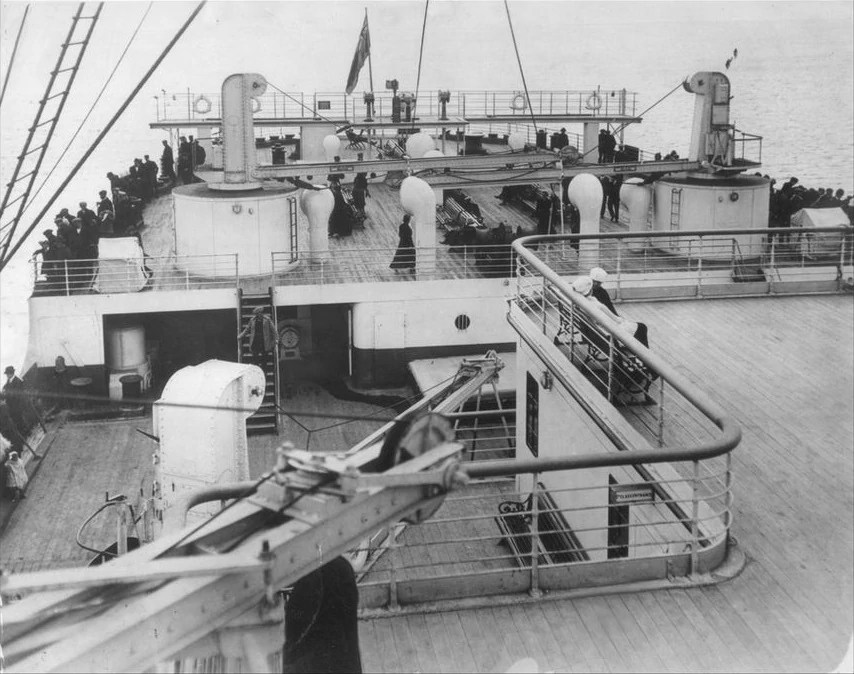
Titanic’s Poop Deck in the background. This image is taken from the boat deck. The crane Abelseth describes is just visible down in the well. You can imagine desperate passengers shuffling up its length to climb over the railings.
Eventually, the gate between third class and first class was opened by a couple of the ship’s officers, and they called out for women and children to come forward. Two women from Abelseth’s group went through while the men dutifully hung back.
By the time Abelseth, his cousin and his brother in law were permitted up on the boat deck, many lifeboats had already been cast off, and the Titanic was well on its way to sinking utterly. Despite opportunities to get on a boat, Abelseth declined, and together with his relatives, he decided to jump into the water just as the ship sank. Striking the freezing cold water, he almost drowned, but was plucked out of the sea when he happened to come across a lifeboat. Tragically his cousin and brother-in-law did not survive the ordeal – they both perished after jumping into the freezing waters of the Atlantic.
The Senators asked Abelseth a final time about the opportunities steerage passengers had to reach the top deck.
The question was;
Do you think the passengers in the steerage and in the bow of the boat had an opportunity to get out and up on the decks, or were they held back?
Abelseth replied;
Yes, I think they had an opportunity to get up.
He was asked;
Were there no gates or doors locked, or anything that kept them down?
Abelseth simply reiterated;
No, sir; not that I could see.
The Senator queried him about the crane that people climbed on to get to the boat deck, and Abelseth quite accurately pointed out that by then, his band of third class passengers were already out in the open air – there had been no restrictions keeping them in their rooms. Remember – he’d gone up and down twice; the first time to see what was going on, the second time to grab his relatives. So Abelseth would have known better than most about any gates or locked doors in his part of the ship.
But then we come to the third witness. And he has a rather different tale.
Daniel Buckley was twenty years old at the time of the sinking. He described to the Senate Hearing how he’d similarly woken up in his steerage cabin, and had reached the boat deck where he’d eventually gotten on a lifeboat with a group of other men.
However, unlike Pickard, these men weren’t so lucky. A couple of officers discovered them before the boat was lowered, and Buckley described how the crewmen had to resort to firing pistols over their heads in order to force the men out of the lifeboat.
Buckley, however, was fortunate. As each man was dragged out, he began to cry, knowing what would happen to him if he was forced out of the lifeboat. Seeing him in such a state, a woman on the seat next to his wrapped him in a shawl to disguise him, and told him to keep quiet.
The ruse worked, and as more women and children were brought onto his boat, the other men were dragged off, all except for Buckley. And he survived to tell his tale. When asked about steerage passengers being locked below decks, he at first gave an ambivalent answer. He said;
I do not think so.
The senator asked him again;
Were you permitted to go on up to the top deck without any interference?
This time he replied;
They tried to keep us down at first on our steerage deck. They did not want us to go up to the first class place at all.
Who tried to do that?
I can not say who they were. I think they were sailors.
What happened then? Did the steerage passengers try to get out?
Yes; they did. There was one steerage passenger there, and he was getting up the steps, and just as he was going in a little gate a fellow came along and chucked him down; threw him down into the steerage place. This fellow got excited, and he ran after him, and he could not find him. He got up over the little gate. He did not find him.
Put to one side the bizarre circumstance of a steward being chased through the ship by an angry passenger he’s just thrown down a set of stairs, Buckley’s response is revelatory. He goes on to explain further about how he had gotten to the top of the stairs and passed through an open gate when a steward appeared and threw back another third class passenger before locking the same gate closed.
The passenger was so outraged, he tore off the lock and chased after the steward.
Buckley was asked to confirm exactly where in the ship he was with the use of a model and some drawings. Again, he was asked the question; did the locking of this gate prevent people escaping the lower decks?
Buckley replied that once the lock had been torn off, it didn’t. But it is evidence that an attempt was made to restrain third class passengers, at least in his part of the ship.
So why might this be done? Could it be because the crew saw steerage passengers as disposable? Did they simply not care and merely see them as a burden?
Well, no.
From the stewards’ point of view, they had been given orders to wake steerage passengers and get them ready to leave. Some followed this order to the letter while others were more liberal, preferring to get the passengers topside as soon as possible.
It’s important to remember – the ship was sinking. People would have been panicking, and up on the boat deck, officers and crew members were furiously working to get lifeboats ready for departure. The last thing they needed were hundreds of desperate passengers pushing forward to get a place on one. It was determined at the hearing that it took about twenty to thirty minutes to get each boat prepared; it was not a simple task.
Undoubtedly, some gates throughout the ship were closed and locked. But they were all open before the first lifeboat began its controlled descent to the waterline. Whether it was from stewards being given the order to permit third class passengers up top once things were prepared, or whether, as Buckley witnessed, it was an impatient passenger with a grudge bursting the lock open ahead of time, one way or another, the gates were open at the crucial moments in the evacuation.
Any gates that were locked, seemed to have been done so out of a sense of need, in the best interest of the passengers. Unfortunately for those in steerage, they had a further distance to travel to get to the upper decks. Just like today, back then, you got what you paid for, and first class paid a lot for their cabins beneath the boat deck where they would find lifeboats waiting.
It’s a similar reason to why third class passengers were so rudely woken from their beds compared to those in first. Many like Abelseth and Pickard didn’t have English as their first language. In the passengers’ best interests, the crew had to make sure they understood what they were being told, they had to shuttle these passengers forwards, physically pushing them on for the boat deck at times.
So were those in steerage kept locked below decks? Ultimately in some parts of the ship for a period of time, yes. But in the same way people in some areas of a large commercial building are told to stay put during a fire, it’s done from a sense that it’s the best course of action for everyone.
I’ll end with Pickard’s final words on the matter when he described the actions of the stewards in a poignant remark. Like many of the crew, the majority of the stewards perished during the Titanic’s sinking.
They tried to keep us quiet. They said, “Nothing serious is the matter.” Perhaps they did not know themselves. I did not realise it, the whole time, even to the last moment. Of course, I would never believe such a thing could happen.
Berk Pickard
The lucky ones. Titanic’s collapsible lifeboat D, just before its survivors are taken aboard the rescue ship RMS Carpathia.
It’s called The Air Between Us, and my royalties are going to charity
It took three full weeks of grinding work to make this a reality. I loved every minute
Never am I happier than when I’m storytelling. I love everything about the process (perhaps apart from the editing), and I feel incredibly lucky to be able to spend time on my craft because it never feels like work.
Originally for this project, I had set myself the goal of creating a full length novel in two weeks. Well, it turns out that was a bit optimistic. It took me three to get it to a place where I was happy with the quality of the story. And it was one hell of a roller coaster journey fuelled with coffee and a Jon Bon Jovi playlist on repeat.
But the moment has arrived – It’s out now at Amazon in eBook format and priced at the very reasonable sum of £1.77. Of that, my royalty is around £1.20, and for every purchase made, I’ll be boosting it to £2.00 (which is approx $2.65 USD) and donating it to my chosen charity: The Alzheimer’s Society. It’s also available as a Kindle Unlimited subscription, and likewise, all royalties from there will also be added to the donation pot. I’ve created a dedicated charity page on my website (Link Here) to provide monthly donation totals, and it will include any future books that I add to my charity library.
For me, finishing any piece of literature is always a bittersweet moment. A part of me wants to continue working on the characters and adding new scenes in the world I’ve built. But as a great philosopher once said; anyone can make something more complicated. It takes vision to keep things simple. While I might lack the vision, having the short time frame to produce a full-length novel has been a great lesson in learning to know what’s important to a story. For The Air Between Us, it forced me to keep only the important bits in, and discard those ideas that would have just been window dressing. As a result, the final book has a very taut, very punchy story that is going to stay with me for some time, and I hope that for anyone who decides to take the plunge and read it, you are left with the same feeling.
Now that this project is over, I have an opportunity to start work on something new. I have a couple of ideas in addition to my ongoing commitment with the Blackchapel Chronicles, and once I’ve made them tangible, I’ll be providing an update very soon. The past week, I’ve been recharging my batteries and reconnecting with people after being holed-up in a room typing on a laptop for so long. Already, I can’t wait to start writing again.
To anyone who does buy the book, thank you so much, it means a lot to me to know someone is reading my words. And if you just read the sample, that’s great too. When all is said and done, my motivation is to reach out to people with my words and provide an entertaining set of stories. There is so much going on in the world these days, settling down with a book feels like one of the last refuges we have left to escape for a precious hour or two.
The book is finished, and I’m getting it (self)published
It feels a lot longer than the two-and-a-half weeks it’s actually been since writing the first page of my very first (and possibly last) romance novel. Getting it over the finish line has resulted in a lot of missed sleep, and hours upon hours of writing and editing that felt like it would never come to an end. It’s been a real slog that’s seen me not shower for three days, and sometimes hardly even acknowledge the existence of my wife at times.
Seriously – she’s actually left me to stay with her parents this weekend and keeps messaging me with photos of all the great things they’re doing. What can I say – I suffer for my art.
It will completely blow me away if people do buy this book, not just for me as a writer, but more importantly for the charity I’m supporting – The Alzheimer’s Society (link goes to their website). I’ve put a lot of work into the quality of the final product, and I’ve even made my own map of Northern France from scratch so readers can follow where the story is at any point. For an idea of what to expect, here’s the synopsis;
My dream is for the short deadline to not be noticeable while reading it. In terms of the book’s format, it will be available first in eBook, then (very soon after) in paperback. Regardless, all my royalties will go to charity so it can make a great gift for someone.
The next post I make on this topic will contain the details on where it can be bought and how much it will cost (it won’t be a lot of money because I never charge a lot – I’m terrible at business). It will also have a ‘look inside’ feature so you can take a peek of the first chapter or two.
Until next time, stay safe & happy writing / reading!
Since I’ve been writing-up a summary to go on the back cover of my latest book, I’ve been thinking about its purpose, and what makes a good one ultimately sell more books, regardless of the quality of the pages’ contents. Many writers work for days on a punchy, hard-hitting blurb to go on that all important back cover or Amazon store page. Word for word, it probably takes up more time than writing the book itself.
The more I’ve reviewed my old blurbs, the more I realise I must subconsciously keep a pattern, regardless of any of my works’ actual content, because they all fit the same kind of structure. So for anyone out there who’s writing their own, or for those who simply have an interest, I’ve laid out my four-step approach to writing this very important bit of marketing for any book:
Photo by Tim Gouw
1. Go straight-in with the setting, and build outwards.
If you’ve written a taut thriller set in Germany at the beginning of WW2, a simple first line of; Berlin, 1938, will speak more to anyone with an interest in the genre better than any amount of expository background. It will also save on word count, which I always plan to have at around 150. Any more than 200, and people switch off and continue skimming the bookshelf. It helps to keep the first line short and sharp to define a book’s genre like a slap round the face. It allows those readers without an interest to move onto something else, and for those that do, to read more.
2. Start personal, you can always explain your book’s world towards the end.
The setting / genre is defined in the first line. Now it’s time to introduce the main character(s). Whether it’s children’s fiction or adult, everyone wants to know who the characters are as soon as possible. They want to know why they should be invested in your character over the course of four hundred pages or sometimes more, and why they should root for them, sympathise with them, laugh with them. The best way I’ve found to achieve this, is to lay out that character’s motivation. If they’re a disgraced hero, put that down. If they’re setting out for vengeance or a lost love, write that in.
Imagine you’re in a lift with Christopher Nolan on your way to the tenth floor. You’ve got twenty seconds to give him a spoiler-free summary of the manuscript you really want him to turn into a movie. He’s not going to care that your main character has a cat called Stanley, works out at the gym four days a week, and has an intolerance to gluten (the main character, not Stanley). He is going to care that the same character was left for dead by her best friend who’s since run off with her husband. So tell him that.
I’ve been cringing at an old summary I once made for a short story I’m now determined will never see the light of day. In it, I described how the main character looked – in the summary. I actually put that in. Since then, I’ve grown up a bit, and I see characters in a blurb as store mannequins that people can project themselves onto. They want the outline of a human being they can care about, so give them one.
3. Don’t give away the plot
Some of the best blurbs I’ve seen hardly give anything away. They’ll grudgingly throw you some morsels before threatening to mug you and kick you out the bookshop. Check out George RR Martin’s Game of Thrones summary next chance you get. It mentions some guy called Eddard Stark who’s Warden of the North. There’s betrayal and vengeance mentioned, along with an Iron Throne, and a Dragon King. And that’s it. Outside the low-fantasy genre setting, you’re left with no idea what’s going on. It makes you want to read more.
Sometimes it’s tempting to show off the hard work you’ve put in with a certain plot twist, and I’ve had to delete entire paragraphs from a summary because I’m getting close to revealing too much without a single page being turned. Less is more, and creating the setting or main character’s motivation is often enough right there in terms of any plot explanation. The reader’s imagination will do the rest.
4. When you end it, don’t just end it
I recently read the summaries of a particular author’s romantic fiction serial since I’m writing my first and was looking for inspiration when it came to my own blurb for this strange and varied genre (my personal opinion). I was a bit put out when the summaries for every book in the series (I think there were four), just…ended. There was no wrap-up, no cliff-hanging teaser, nothing. It just ended after a connecting sentence as though the printer had missed off the last twenty words.
The blurb’s end is probably as important as the beginning, since it’s the last words any potential reader will see before they (might) turn to the first page of your book. For mine, I always stick to the same formula, and it may not be the best, but here goes; I essentially remind any future cherished reader why I think they should buy my book. I draw them from the bowels of the plot and give a wide-ranging view of the body of work. Maybe the setting changes from the wet and rainy streets of modern London to the dusty plains of the Australian outback? Maybe there are twists and turns along the way? Maybe the book is going to evoke feelings of nostalgia, or a sense of loss? If I was ever given an award for my writing (never gonna happen), I’d remind them of that. In short, I’m trying to give a closing argument on why they should take a risk with my book instead of going for the safe option from tried and tested James Patterson.
And that’s it. That’s what I think through when creating a book summary.
To illustrate the above points, here’s the blurb for my new book that will be getting put to market just as soon as I’ve finished the damned editing today. You can probably see the four rules I’ve followed in order to create it.
My method might not be the best way to create the most compelling summary, and it certainly won’t work for every genre and style. If you happen to be a wordsmith yourself, drop me a note on how you tackle this thorny issue – I’m always interested to see how other writers overcome the problems we all face, often alone.
Going to bed last night, I was really, really worried. I had no book blurb, I had no front cover, I wasn’t even happy with the title I’d decided on for my completed manuscript. In short, I had a completely blank slate for a brain after 10 o’clock.
My wife was already fast asleep by the time I slid under the covers and drifted off, thoughts of failure etched on my mind. Then 2.30am rolled along. I snapped awake. My mind was on fire; I knew exactly how the cover was going to look, I had a better title – I even had a tagline. Whipping back the cover, I leapt out of bed, dashed into my study, turned on the computer, and…and…
It didn’t f***ing work! My computer had died during the night like my pet hamster from childhood. Painful flashbacks ensued.
So I got out my old Chromebook that has a broken ‘up arrow’ on the keyboard, and the ‘a’ and ‘s’ letters worn off their keys. And with it, I produced this…
For someone who failed Art & Design at school, I’m a little bit proud of it, and I feel it fits the mood of the book really well. Now that this project has an actual cover, it also feels a lot more real, and my biggest fear has gone from being; “will I be able to complete this?” to “will anyone like this book enough to actually pay money for it?”
Any and all royalties will be going to a charity close to my heart, and to ensure every penny gets to where it needs to be, I’m not recouping any incurred costs. Having begun this whole thing as a bit of a fun joke, I really want this book to stand as a good story in its own right. To that end, my philosophy in writing has always been the same; keep trying, don’t give up, and if you produce something that is entertaining, people will buy it.
And for any chance of that to happen, I have to get back to the soul-crushing work of editing.
I’ve written the final part of my manuscript while listening to Bon Jovi. Guess I’m…Livin’ On A Prayer?
At this point, the days have rolled into one and there just aren’t enough hours. My manuscript is finally finished and the word count stands at a respectable 81,000(!) Yet I have a shed load of editing to do, and a difficult decision to make. The choice before me is whether I rush this last part of the project to (almost) meet my self-imposed deadline, or go over that deadline to create a more engaging and polished story.
As this challenge has gone on, my biggest worry has come from not being able to do the story justice. What started as a whimsical project to raise some cash for a great cause has become a labour of, if not love, then something close to it. Coupled with respecting the book’s historical setting, I’ve come to realise I don’t want to screw this up after coming so far. I first began writing to produce something that people want to read, and I hope that by pushing back the deadline a little, I get closer to that goal, and ultimately raise more money for charity in the long run.
Therefore, I’ve decided to dedicate three additional days to do the editing and cover design before publishing this thing. In hindsight, to go from nothing, not even a story outline, to having the rough manuscript completed in two weeks has been an undertaking in itself. Now that I have it in my hands, it feels much more real, and the end is very much in sight.
I’m hoping to post the finished book cover tomorrow, and the book’s blurb the day after. Since the exhausting task of writing page after page is at least done, I’ll be able to post more updates over the coming days, culminating in the final (definitely final) novel very shortly.
Until then, please check out my chosen charity’s website here at: www.alzheimers.org.uk and as always, happy writing!
Before I go any further in this post, I have massively fallen behind on my updates, so I’m wrapping this one into days 6 & 7 – It’s that kind of a project.
At the end of the first week, I have (some would say inevitably) fallen behind by about 10,000 words. So to try and catch up, I’m intending to pull an all-nighter tonight (Tuesday) and then work through the next day until I eventually collapse on Wednesday evening. My current word count stands at 40,000. A mix of personal stuff and re-drafting had slowed things down over the weekend.
On the positive side, I’ve really begun to like some of the characters I’m writing, which is something I was not expecting in a romance novel. Before this, I would have scoffed at such an idea, having wrongly believed the genre was nothing more than two-dimensional mush wrapped up in three-day old bubblegum. More fool me.
There is one character getting under my skin more than the others though, and that is the main antagonist. Somehow I’ve allowed him to morph into a real villainous piece of sh*t. There’s nothing wrong with having an evil villain (in fact it’s the aim, after all) but I do try and set a limit in keeping with the theme of the story, and this guy is pushing it. I’ve known of a few writers whose characters morph in ways they hadn’t originally expected them to, and it’s always been fascinating to me; as their creators, you’d think we could keep to a rigid set of characteristics and stick to them, never deviating from the path. Yet they always seem to creep out the page with a life of their own.
The other thing I have to keep my eye on is the charity element of this book – I’m donating all my royalties to charity, and therefore any organisation associated with this project is probably not going to want it to be too graphic/controversial. On the other end of the scale, I’m a thriller writer who has never censored himself for anything, so there is a large push-pull going on inside my head right now.
Anyone who might have been following my clues in earlier posts may already have got this, but the majority of the book is set against the backdrop of World War One, which is quite fitting considering the awful events currently taking place in Ukraine and threatening to spill across Europe. The nice thing about writing, especially fiction writing, is how it allows you to shut the door on the outside world for a short time and seek solace in one that you can create anew from your own desk.
In portraying events of the Great War, I’ve been careful not to take too many liberties with history, or with the achievements of those who fought on the front lines, struggling against impossible odds on both sides of the conflict. To that end, I put extra research into some of the key events the story follows in order to maintain some authenticity and realism, and I hope the final product will stand as a testament to the sacrifices made by the generation of my grandparents and great-grandparents.
The speck of light at the end of the tunnel is visible in this project. Yet I still have the book’s front cover to start (hopefully by the weekend) and the front & back matter to do as well. There’s just not enough hours in the day…
Another busy day today, this one with more editing to get things slightly closer to the finished product. I can now say with confidence that romance novels are definitely not my thing.
However, some exciting news – today I’m sharing my second draft of chapter one! Be aware that this is not the final article, and events / characters are subject to change.
Spelling and grammar errors are also likely, and the story contains adult themes. Reader discretion is advised.
I don’t think any romance writers out there have got anything to worry about from me, but I’m always grateful for feedback from both readers and fellow writers, especially on a lightning fast project like this where time really isn’t on my side (at least its all for a good cause).
From the chapter’s setting, you’ll probably have a few clues on where this story is going to go. Suffice to say, it’ll have a few twists and turns along the way before everything gets resolved. There’s more to come tomorrow, but for now I hope you enjoy reading the draft.
If you’re brand new to this, the title pretty much describes my situation, but if you want the details, it all began here. I’ve been completely snowed under with the actual writing part of this challenge during the last twenty four hours. For about sixty minutes I just stared at my laptop screen, agonising over four sentences, then blitzed about 3,000 words in an hour and a half. Writing is weird, isn’t it?
So I made the decision to mash these two days together into one update. I’m planning to have the second draft of chapter one posted tomorrow to give a flavour of the story. In the meantime – here’s a progress table;
PLOT
Stuff is generally happening. Right now, the two main characters are about as far apart relationship-wise as they’ll ever be (or close to it). Nefarious deeds are going on in the background and oodles of heartache is on the horizon. I’m hoping to reach a major action scene tomorrow, but if not then it’ll be a day five job.
CHARACTERS
This is one area that is completely done. Both heroes and villains are fully realised with most characters falling somewhere between the two.
THEMES
I’m going to leave this one mostly unsaid from here on out. There is a strong theme that runs through the manuscript on both the male and female side of the relationship (this is a heterosexual love-interest novel). The theme is different for both characters and I’ll let the reader discover what it is for themselves.
BOOK COVER/DESIGN
Pfft. Get out of here. Come back in about nine days for this one.
FRONT & BACK MATTER
See book cover/design
WORD COUNT
This is the big daddy. I can have all the themes and story lines I like, but if it’s not on the page, it’s not a novel. I will be ending the third day with about 15,000 pretty good words. Still not as far as I would have wanted, and it’s (mostly) as close to a first draft as you can get, but it’s a start. Isn’t it?
EDITING
Currently reviewing the second draft of the first chapter. Hope to get as far as the third by end of today. It badly needs it.
On the plus side, I think I’ve got a title, although I’m hovering between two strong potentials and it could go either way.
On the negative side, my coffee machine has broken. For once I am lost for words at this tragedy.
Same as my last update, I’ll end this one with a clue as to the novel’s setting. Gold star to anyone who can guess when/where/what this is;








 Michael Averon