Why Were The Titanic’s Lifeboats Not Fully Loaded?

There were enough spaces for 1178 people. But only 706 were saved.

Still image from a movie, A Night to Remember, starring Kenneth Moore
A Still from A Night to Remember, with a revolver-wielding Lightoller played by Kenneth Moore

One of the enduring tragedies of the Titanic disaster is the knowledge that so many people perished unnecessarily. Given the fact that this massive ocean liner didn’t carry enough lifeboats to save all crew and passengers in the event of its sinking, we can be forgiven for scratching our heads over the actions of its officers who allowed lifeboats to be lowered less than half full.

How could it have been justified?

Ever since the first news stories were printed following the sinking, a perpetual myth has become ingrained in Titanic’s story. It’s one that cites a lack of organisation in the crew, and of a panic in the ship’s officers who rigidly stuck to their orders of ‘women and children first‘. Stories still abound in the form of books and film that reinforce the image of the Titanic’s officers cruelly (and unnecessarily) hauling terrified men & boys from lifeboats only to lower them half empty to the sound of screamed exhortations from wives & daughters.

Like most stories from history, the truth of why so many lifeboats were lowered at minimal capacity has a simple explanation, and it’s one that is staring us right in the face. All we have to do is go back to the source material. And in this case, from testimonies of the survivors & witnesses themselves…

The Hero: Arthur Rostron, Captain of the Carpathia

Black and white contemporary photograph of Captain Arthur Rostron receiving an award

The passenger steam ship, Carpathia, was bound for Liverpool from New York when it picked up the distress call from Titanic at 12.35am on 15th April 1912. Its Captain, Arthur Rostron was rudely woken out of bed by his telegraph operator who had barged into his quarters to madly give him the news.

Realising at once the grave situation, and knowing his ship was 58 miles from the Titanic, Rostron gave the order to change course and make for the sinking liner. In a flurry of commands, he had his boilers strained to their maximum output and hurriedly converted his passenger vessel into a hospital ship in anticipation of receiving wounded. Despite his quick thinking and the efforts of his crew, the Carpathia would arrive too late to save anyone from the Titanic directly – the great ship would sink beneath the waves 2 hours before the rescue ship made it to the wreck site. All Rostron and his crew could do was pick up frozen and terrified survivors bobbing around in lifeboats in the middle of the Atlantic.

Deciding to return his now packed ship to New York, Rostron arrived into harbour on the 18th April and was called to a hastily-assembled Senate Inquiry the very next day. Without any time to prepare, the Captain gave a good account of his actions and was lauded by all those present.

It didn’t take long however for the Senate Chairman, Senator William Smith, to ask about the topic of lifeboats;

How many lifeboats did the Carpathia carry? he demanded.

Twenty, came the reply.

What tonnage is the Carpathia?

Rostron was terse in his response; 13,600 tons.

Discussion then pivoted to the Titanic;

How many lifeboats did the Captain believe were held on the Titanic?

Again, the answer of twenty was given

And what tonnage was the Titanic?

45,629 tons

Did Captain Rostron believe there was a problem in this discrepancy since the Carpathia held as many lifeboats as a newer ship that was 3 times as large? Surely a number closer to sixty should have been available on the Titanic?

Rostron’s pragmatic reply gives us an insight into the prevailing attitude of the time;

“The ships are built nowadays to be practically unsinkable, and each ship is supposed to be a
lifeboat in itself. The boats are merely supposed to be put on as a standby. The ships are supposed to
be built, and the naval architects say they are, unsinkable under certain conditions. What the exact
conditions are, I do not know, as to whether it is with alternate compartments full, or what it may be.
That is why in our ship we carry more lifeboats, for the simple reason that we are built differently from
the Titanic; differently constructed.”

Captain Arthur Rostron

His argument is a simple one; because the Titanic was of a modern, safer design, the authorities who drew up the regulations considered it to be a giant lifeboat in itself, capable of staying afloat until another ship on the busy sea lane could arrive to ferry the passengers to safety.

This act of hubris by the British authorities would contribute to the deaths of over 1,500 people in the freezing waters of the Atlantic. It also factored into the thinking by the Titanic’s officers as they helped hundreds of terrified passengers climb into her lifeboats. And this is illustrated perfectly by answers given to the Inquiry by its Second Officer, Charles Lightoller.

The Warrior: Charles Lightoller, Second Officer of the Titanic

Black and white photograph of Charles Lightoller

Like Rostron, Lightoller was summoned to the Waldorf Astoria where the Senate Inquiry had been assembled the day after the Carpathia had docked. And just like Rostron, he was woefully unprepared for the pointed questioning he’d be placed under.

Aged 38 at the time of the sinking, Lightoller had been the Second Officer of the Titanic, and was pivotal in how the port-side lifeboats had been filled, lowered and sent away from the ship. He had, under his own initiative, organised the evacuation on the port boat deck. He had ordered 2 crew members into each boat for them to take charge once it had been lowered.

The orders given from the Titanic’s captain had been for women and children first, but from Lightoller’s actions, it is clear he interpreted the orders to be women and children only. There are accounts of him dragging men from a lifeboat after they had leapt in just as it was being lowered. He even stated to the Inquiry how he was struggling to find women to put into the final lifeboat, and he casually explains just how many people he allowed in each one.

We take up the questioning at the point where he is asked directly just how many people he placed inside the first lifeboat;

In the first boat I put 20 or 25.

How many men?

No men

How many seamen?

Two

He is then asked what the capacity of the lifeboat was, and he responded;

“Sixty-five in the water.”

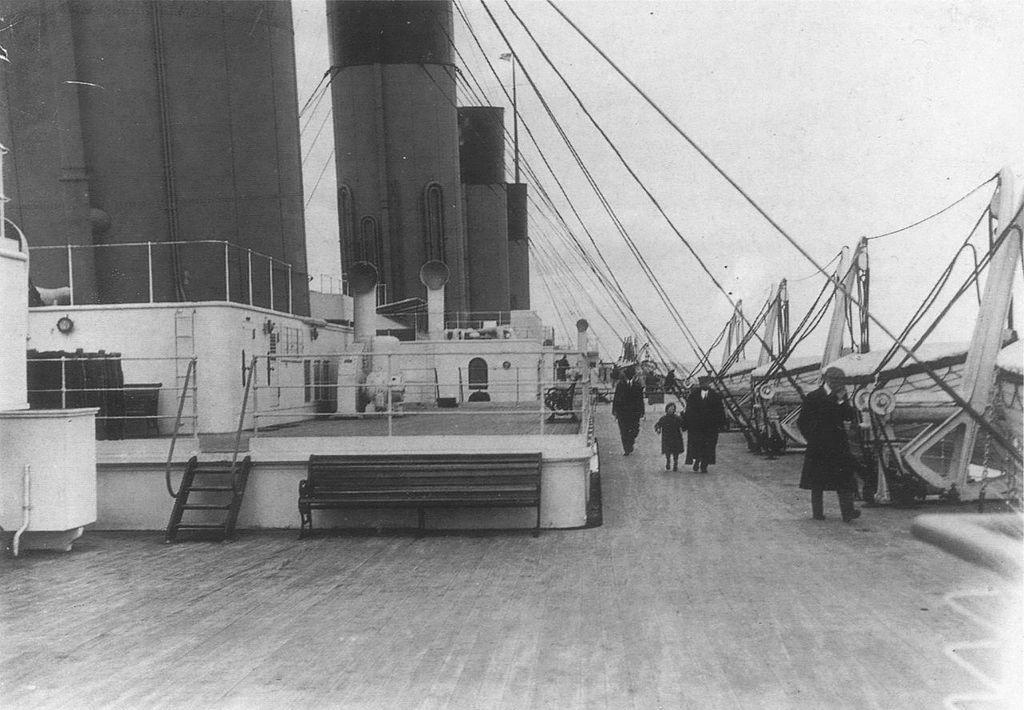
Senator Smith then suggests each lifeboat can safely hold forty when being lowered, but Lightoller quickly corrects him by stating only twenty five can be safely loaded. The reason for this was the ship’s davits. A davit is a crane-like apparatus designed for lifting and lowering items from the side of a ship (such as a lifeboat). On the Titanic, they were made of steel and were doubled-up so that each davit supported the forward arm of one boat and the aft arm of the next one along (see photograph below).

Contemporary photograph of the Titanic's boat deck, showing her lifeboats held in davits
Photograph from the Titanic’s boat deck showing davits supporting the lifeboats

But suspending laden boats in this way placed an enormous strain on their keels, and on the davits themselves. The crew of the Titanic, including Lightoller, were aware of this, and as a precaution, they only began the evacuation by placing around 25 people aboard. When questioned, Lightoller explained that he wasn’t aware of the seriousness of their situation when the order was first given to start loading the boats, and so he rigidly stuck to this 25 limit to prevent any sudden collapse and loss of life.

What he didn’t know was that the keel of each lifeboat had been reinforced with steel, and that the White Star Line, who owned the Titanic, had successfully tested the lifeboats on the davits at their maximum capacity of 65. The results of these tests were never passed to the Titanic’s crew, and they were not aware it would have been safe to fully load each boat with 65 people before lowering.

Even at the time of his Senate questioning, Lightoller was blissfully ignorant that his caution in loading the boats had been for nothing. When pressed by Senator Smith, he admits he began loading boats with more and more women as the gravity of their situation became apparent;

Senator SMITH; How many people did you put into it?

LIGHTOLLER: I might have put a good deal more; I filled her up as much as I could. When I got down to the fifth boat, that was aft.

Senator SMITH; You were still using your best judgement?

LIGHTOLLER: I was not using very much judgement then; I was filling them up.

The Senator assumed Lightoller meant he was now filling them to their capacity of 65, but this was wrong. Lightoller himself stated he didn’t knowingly load any of the port-side lifeboats with more than 35 people. For a Second Officer so used to following strict rules and regulations, he was throwing caution to the wind by doing what he saw as overloading his lifeboats. His original intention was for the boats to remain close to the ship once they were safely in the water and collect those passengers remaining onboard. He had portholes opened, and even a gangway door in the hope that terrified passengers would be encouraged to leap into bobbing lifeboats below.

But it was all to no avail. In the pitch black dark with no method to communicate between the Titanic and her lifeboats, there was never any hope of a co-ordinated evacuation. The portholes and gangway door he’d opened only hastened the sinking by providing another access route for incoming seawater. Many of those in the lifeboats were only too keen to row to safety or risk being sucked down with the sinking ship.

Underwater photograph of the Titanic wreck showing a single davit remaining
A single davit visible from the wreck of the Titanic

Yet it is impossible to blame Lightoller for not loading more people into his lifeboats. It is clear that at some point in the evacuation, Captain Smith of the Titanic had a nervous breakdown, and each officer, whether alone or in pairs, was left to rely on their own initiative. Even the Captain’s famous order of Women and Children First was never properly communicated or explained to Lightoller, who stuck to it without guilt or hesitation. In his mind, until the last woman and child had been safely placed aboard a lifeboat, no man should have been given a space.

The Tragic Conclusion

So why were Titanic’s lifeboats only part-filled? Far from it being due to blind panic from the crew, it was an over-abundance of caution that resulted in so many empty seats going unfilled. It was caution in the underestimated strength of those little wooden boats, and confidence in the overestimated strength of the Titanic. It was this lethal combination of an untested hubris in ocean-liner design, and an over-reliance on dogmatic regulations that ultimately led to unnecessary loss of life. If only The White Star Line had communicated the true strength of the davits and their lifeboats. If only they had conducted live drills as part of the Titanic’s sea trials instead of just testing the gear itself, perhaps many more lives would have been saved.

I’ll end with Lightoller’s response when he was asked if he would have done things differently in hindsight, knowing the true scale of the disaster;

I would have taken more risks. I should not have considered it wise to put more in, but I might have taken risks

Charles Lightoller
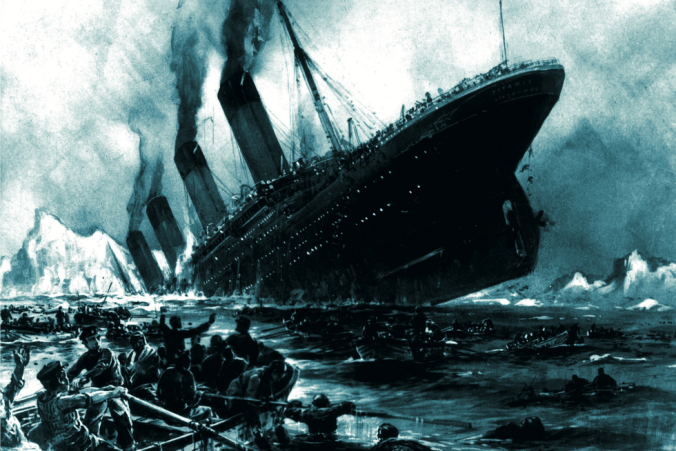
Artist's depiction of the Titanic's sinking

Were Titanic’s Third Class Passengers Really Locked Below?

The Truth Might Surprise You

A still from Titanic 1997 showing third class passengers locked
A still from the film, Titanic, 1997

It seems everyone has heard the story of RMS Titanic. At the time of its completion, it was the largest ocean liner in history, grossing more than 46,000 tonnes and coming in at over 882 feet long. This huge ship was widely lauded as the future of transatlantic shipping only for it to sink in the early morning hours of 15 April 1912 in the North Atlantic Ocean, just four days into her voyage from Southampton, England, to New York City. The ship had more than 2,200 people on board when she struck an iceberg just before midnight on the 14th April. She sank to the bottom of the ocean two hours and forty minutes later, resulting in the deaths of more than 1,500, making it one of the deadliest maritime disasters in history outside of war.

Thanks to popular culture, we have images of those passengers in third class whose cabins were located in steerage, trapped below decks behind metal-railed gates while the ship sunk, prevented from getting up to the top decks where they could find lifeboats and salvation. All of it creates a poignant, almost melancholic defeatism about the class system at the turn of the 20th Century. But the question I’m going to ask in this post is: Were third class passengers really locked below?

Titanic painting by Harley Crossley
Painting by Harley Crossley

Like many enquiries into the past, the answer can be found in the contemporary source documents. Following the Titanic disaster, there were two inquiries; one was set up by the British Board of Trade, and the other was conducted by the United States Senate. Their job was to question those who survived the sinking to determine what happened, why it happened, and how it could be stopped from happening again. 

Both inquiries generated many hundreds of pages, and they reached many similar conclusions into what happened. I’ve trawled through their reports and witness testimony, and it is as fascinating as any court drama I have ever seen.

Focusing on the third class passengers, I was able to draw out the witness testimonies of three men, all of them survivors from third class. At some point in their interviews, each man was asked the same specific question – were you prevented from getting access to the upper decks? Using their testimonies and knowledge we now have of the event, I’m going to answer this question (hopefully) once and for all.

And I’m going to start with the testimony of a man called Berk Pickard.

Pickard has a really interesting background. He was born in Russia as Berk Trembisky before he left for France. Once in France, he took the French name of Pickard, and kept it for the rest of his life.

Stood before the United States Senate, he affirmed that he was in steerage sharing a cabin with a group of other men when the ship struck the iceberg, and he first knew of the collision at ten minutes to midnight when he was woken by a tremor running through the ship.

In his own words he states;

We had all been asleep, and all of a sudden we perceived a shock. We did not hear such a very terrible shock, but we knew something was wrong, and we jumped out of bed and we dressed ourselves and went out, and we could not get back again.

Berk Pickard

He then goes on to describe how he found some stewards already making their way down the passageway, waking up other passengers and shuttling them towards the upper levels. Pickard realised the seriousness of the situation and decided to go back to his cabin to get more belongings when he was stopped by a steward. He told the Senate how the crew would not allow the steerage passengers on this part of the ship to go back.

So far from keeping the passengers below decks, in this part of the ship at least, the crew were actively getting them out towards the top deck. Pickard continued to describe how he climbed up to another level where he found a group of passengers arguing. He stated;

One group said that it was dangerous and the other said that it was not; one said white and the other said black. Instead of arguing with those people, I instantly went to the highest spot.

Berk Pickard

He climbed his way up to an area for second class and stopped at a door. It was clearly marked for first class passengers only. Yet fortunately for Berk, it was left open, so he went on through. But then he had another problem – he had no idea where he was – he hadn’t been in this part of the ship before.

Imagine you’re suddenly in his shoes. The Titanic is sinking, and the deck you’re on is tilting ever further towards the waterline. Should you go left or right? Should you go down the first corridor you come to or do you try to seek out a set of stairs? After some time spent wandering around, Berk manages to get to the top deck where he came across a group of women and children boarding a lifeboat. Without saying a word, he climbed inside with a group of other men, and was lowered into the water where they rowed to safety. Once they were a safe distance, they all watched to the sounds of cries and screams as the ship sank, plunging to the depths far below.

Towards the end of his testimony, he was asked directly about any barriers that might have prevented him from getting to the upper decks. This is what he said;

The steerage passengers, so far as I could see, were not prevented from getting up to the upper decks by anybody, or by closed doors, or anything else. While I was on the ship no one realised the real danger, not even the stewards. If the stewards knew, they were calm. It was their duty to try to make us believe there was nothing serious. Nobody was prevented from going up.

Berk Pickard
Titanic's boat deck
Titanic’s boat deck. Note the covered lifeboats on the right hand side

This is as clear as you can get. In Pickard’s part of the ship, there were no restrictions in getting third class passengers away to safety. And this is reflected in the second witness testimony from my research; a man called  Olaus Abelseth.

Abelseth was twenty five at the time of the sinking. He was from Norway, and had gone to Southampton with his cousin and his brother-in-law to seek their fortune in the United States. He confirmed at the time of the collision how he was down in steerage after having gone to bed at 10 o’clock. He shared his third class cabin with one other man, and both of them were woken by a tremor running through the ship. Realising something was wrong, they both got dressed, and like Pickard, they left their cabin to go find out what was happening. 

Abelseth told the Senate that he reached the top deck without any problems only to realise he had left his lifebelt behind. Seeing all the commotion, he realised something bad must have happened. So he went back down, grabbed his lifebelt and went to find his cousin and brother in law since they slept in a different cabin to him. After waking them up, he led the groggy pair up the ship’s decks and the trio somehow joined a group of Norwegians they had met previously during their voyage. Together as a single group, these Norwegians eventually found themselves standing outside at the rear of the ship.

Abelseth called this part of the ship the hind part, and the Senators had to have it confirmed to them where exactly he was at this point. He was actually on the poop deck, which was used as a promenade for third class passengers.

This is very different from the boat deck. There is a level change and a railing with a locked gate that during normal cruising would stop third class passengers from mingling with those in first class. Abelseth describes seeing many passengers from steerage, climbing a crane arm to get up on the boat deck where all the activity around the lifeboats was taking place.

He said;

There were a lot of steerage people there that were getting on one of these cranes that they had on deck, that they used to lift things with. They can lift about two and a half tons, I believe. These steerage passengers were crawling along on this, over the railing, and away up to the boat deck. A lot of them were doing that.

Olaus Abelseth
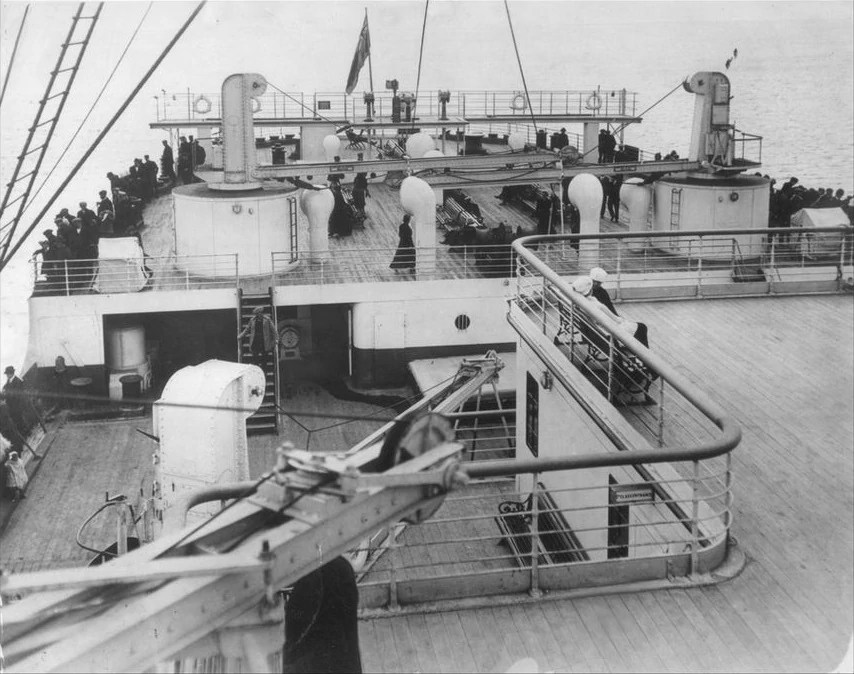
Titanic’s Poop Deck in the background. This image is taken from the boat deck. The crane Abelseth describes is just visible down in the well. You can imagine desperate passengers shuffling up its length to climb over the railings.

Eventually, the gate between third class and first class was opened by a couple of the ship’s officers, and they called out for women and children to come forward. Two women from Abelseth’s group went through while the men dutifully hung back.

By the time Abelseth, his cousin and his brother in law were permitted up on the boat deck, many lifeboats had already been cast off, and the Titanic was well on its way to sinking utterly. Despite opportunities to get on a boat, Abelseth declined, and together with his relatives, he decided to jump into the water just as the ship sank. Striking the freezing cold water, he almost drowned, but was plucked out of the sea when he happened to come across a lifeboat. Tragically his cousin and brother-in-law did not survive the ordeal – they both perished after jumping into the freezing waters of the Atlantic.

The Senators asked Abelseth a final time about the opportunities steerage passengers had to reach the top deck. 

The question was;

Do you think the passengers in the steerage and in the bow of the boat had an opportunity to get out and up on the decks, or were they held back?

Abelseth replied;

Yes, I think they had an opportunity to get up.

He was asked;

Were there no gates or doors locked, or anything that kept them down?

Abelseth simply reiterated;

No, sir; not that I could see.

The Senator queried him about the crane that people climbed on to get to the boat deck, and Abelseth quite accurately pointed out that by then, his band of third class passengers were already out in the open air – there had been no restrictions keeping them in their rooms. Remember – he’d gone up and down twice; the first time to see what was going on, the second time to grab his relatives. So Abelseth would have known better than most about any gates or locked doors in his part of the ship.

But then we come to the third witness. And he has a rather different tale.

Daniel Buckley was twenty years old at the time of the sinking. He described to the Senate Hearing how he’d similarly woken up in his steerage cabin, and had reached the boat deck where he’d eventually gotten on a lifeboat with a group of other men.

However, unlike Pickard, these men weren’t so lucky. A couple of officers discovered them before the boat was lowered, and Buckley described how the crewmen had to resort to firing pistols over their heads in order to force the men out of the lifeboat. 

Buckley, however, was fortunate. As each man was dragged out, he began to cry, knowing what would happen to him if he was forced out of the lifeboat. Seeing him in such a state, a woman on the seat next to his wrapped him in a shawl to disguise him, and told him to keep quiet.

The ruse worked, and as more women and children were brought onto his boat, the other men were dragged off, all except for Buckley. And he survived to tell his tale. When asked about steerage passengers being locked below decks, he at first gave an ambivalent answer. He said;

I do not think so.

The senator asked him again;

Were you permitted to go on up to the top deck without any interference?

This time he replied;

They tried to keep us down at first on our steerage deck. They did not want us to go up to the first class place at all.

Who tried to do that?

I can not say who they were. I think they were sailors.

What happened then? Did the steerage passengers try to get out?

Yes; they did. There was one steerage passenger there, and he was getting up the steps, and just as he was going in a little gate a fellow came along and chucked him down; threw him down into the steerage place. This fellow got excited, and he ran after him, and he could not find him. He got up over the little gate. He did not find him.

Put to one side the bizarre circumstance of a steward being chased through the ship by an angry passenger he’s just thrown down a set of stairs, Buckley’s response is revelatory. He goes on to explain further about how he had gotten to the top of the stairs and passed through an open gate when a steward appeared and threw back another third class passenger before locking the same gate closed. 

The passenger was so outraged, he tore off the lock and chased after the steward.

Buckley was asked to confirm exactly where in the ship he was with the use of a model and some drawings. Again, he was asked the question; did the locking of this gate prevent people escaping the lower decks?

Buckley replied that once the lock had been torn off, it didn’t. But it is evidence that an attempt was made to restrain third class passengers, at least in his part of the ship.

So why might this be done? Could it be because the crew saw steerage passengers as disposable? Did they simply not care and merely see them as a burden?

Well, no.

From the stewards’ point of view, they had been given orders to wake steerage passengers and get them ready to leave. Some followed this order to the letter while others were more liberal, preferring to get the passengers topside as soon as possible.

It’s important to remember – the ship was sinking. People would have been panicking, and up on the boat deck, officers and crew members were furiously working to get lifeboats ready for departure. The last thing they needed were hundreds of desperate passengers pushing forward to get a place on one. It was determined at the hearing that it took about twenty to thirty minutes to get each boat prepared; it was not a simple task.

Undoubtedly, some gates throughout the ship were closed and locked. But they were all open before the first lifeboat began its controlled descent to the waterline. Whether it was from stewards being given the order to permit third class passengers up top once things were prepared, or whether, as Buckley witnessed, it was an impatient passenger with a grudge bursting the lock open ahead of time, one way or another, the gates were open at the crucial moments in the evacuation.

Any gates that were locked, seemed to have been done so out of a sense of need, in the best interest of the passengers. Unfortunately for those in steerage, they had a further distance to travel to get to the upper decks. Just like today, back then, you got what you paid for, and first class paid a lot for their cabins beneath the boat deck where they would find lifeboats waiting.

It’s a similar reason to why third class passengers were so rudely woken from their beds compared to those in first. Many like Abelseth and Pickard didn’t have English as their first language. In the passengers’ best interests, the crew had to make sure they understood what they were being told, they had to shuttle these passengers forwards, physically pushing them on for the boat deck at times.

So were those in steerage kept locked below decks? Ultimately in some parts of the ship for a period of time, yes. But in the same way people in some areas of a large commercial building are told to stay put during a fire, it’s done from a sense that it’s the best course of action for everyone.  

I’ll end with Pickard’s final words on the matter when he described the actions of the stewards in a poignant remark. Like many of the crew, the majority of the stewards perished during the Titanic’s sinking.

They tried to keep us quiet. They said, “Nothing serious is the matter.” Perhaps they did not know themselves. I did not realise it, the whole time, even to the last moment. Of course, I would never believe such a thing could happen.

Berk Pickard
Titanic's lifeboat collapsible D. Image taken from the Carpathia
The lucky ones. Titanic’s collapsible lifeboat D, just before its survivors are taken aboard the rescue ship RMS Carpathia.

Next Titanic Article: Why Were the Titanic’s Lifeboats Not Fully Loaded?